Professor Angela Smith is giving a paper with Michael Higgins at an online roundtable and workshop organized by the Maison Française d'Oxford (MFO). The two-day event, to be held on May 6th and 7th 2021, is called ‘Women, and the Politics of Civility/Incivility in Parliament and Public Life’ and will reflect on the profoundly aggressive nature of recent discourse and actions associated with the Brexit debate, the responses to Covid-19, Black Lives Matter, and the consequences for parliamentary and public life. Angela's paper will be given in the panel called 'Women and the Language of Incivility'. Information about how to register for the event can be found here.
Showing posts with label conference paper. Show all posts
Thursday, May 06, 2021
Women and the Politics of Civility/Incivility in Parliament and Public Life
Friday, December 06, 2019
The semiotics of British butter in the context of Brexit
Professor Angela Smith has recently given a paper at the 6th FoodKom seminar in Stockholm. She considered the semiotics of butter packaging in the British context, to explore how national identity is represented. Angela argued that since 2016 national identity has become a central theme in the packing of British butter, whether this is a supermarket own brand, or a leading dairy producer. The absence of cows in this packaging is part of a long-running semiotic practice that seems to relate to the industrialisation of the dairy industry in Britain, but the raising of national symbols seems triggered by the threat to the UK dairy industry that Brexit embodies. Through the exploration of the changes made to one specific brand, Anchor, Angela showed how both of these strands have lead to the redesigned packaging we find now.
Tuesday, September 24, 2019
Borges and beyond
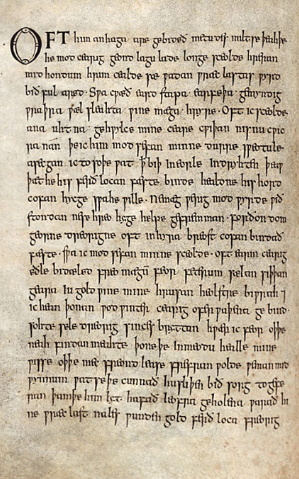
Dr Miguel Gomes has recently given a paper at the 31st International Conference of the Spanish Society for Medieval English Language and Literature (SELIM). Entitled 'Borges and Beyond: Reception and Translation of The Old English Dialogues of Solomon and Saturn in the Spanish Speaking World', Miguel's paper explored Borges’ interest and understanding of these rather unusual Anglo-Saxon texts featuring King Solomon and the pagan Saturn. Miguel explored Borges’ engagement with these texts from a perspective taking into account both recent scholarship and a number of translations of the Dialogues into other modern languages.
Tuesday, March 19, 2019
Translating the Old English elegies into Spanish
Dr Miguel Gomes has recently returned from Traductio et Traditio Mediaevales - a conference in Spain dedicated to written culture as a tool for knowledge transmission. Miguel gave a paper which examined the spatial and cultural shifts involved in the translation of Old English
literature into a language other than modern English, focusing on his own recent translation of the Old English elegies into Spanish verse,
whilst discussing some of the difficulties encountered when rendering the
‘original’ texts into this target language for a contemporary readership.
Friday, July 27, 2018
Slow tv
Professor Angela Smith has given a paper at the 26th Ross Priory International Seminar on Broadcast Talk 2018. Entitled 'Slow tv: the mesmerising antidote to political maelstroms', her talk traced the emergence of 'slow TV' as the antithesis of the fast-edited, fast-paced television that has developed as the dominant concept of the medium in the twenty-first century. More recently, it has been heralded as the antidote to the rise of right-wing populist noise.
Whilst the early cable channels showed ambient images of burning fires or tropic fish tanks, slow tv is slightly more dynamic and deliberately edited to be relaxing as well as informative. Many of the visual tropes in slow tv come from arthouse cinema, particularly the lingering shots and sense of stillness. Unlike ambient tv, it has a narrative but not all of them have a narrator. The narrative is sometimes left to the viewer to work out, such as the original slow tv show, Train Ride: Bergen to Oslo (2009). Others have on-screen captions, such as The Ghan (2013). Where voice-over narrative does exist, it is descriptive and lacking in the usual tropes of drama. Angela's paper argued that the defining feature of slow tv is the narrative, but that this takes many different forms.
Wednesday, July 25, 2018
Vikings in Galicia
| Replica Viking ships in Catoira, Galicia (Source: Wikipedia) |
Dr Miguel Gomes has recently spoken at the International Medieval Congress at the University of Leeds (Europe's largest gathering in the humanities). In his paper, entitled 'Vikings in Galicia: Popular memory, festivities and traces of the resistance', Miguel examined Nordic incursions in the northwest of the Iberian peninsular, considering the way in which over two hundred years of Viking activity in Galicia had an impact on the local landscape as recently analysed by H. Pires (2017), and how those changes might have inspired the formation of many local legends, tales, and celebrations which have kept the Viking element alive in the landscape of people’s minds.
Tuesday, March 13, 2018
Hypermasculinity, Twitter and #MAGA
Professor Angela Smith has recently given a paper at the 'Approaches to Discourse' conference at Georgetown University (Washington DC). She spoke on the concept of hypermasculinity, which was first
theorised in the early 1980s. At that time masculinity was often perceived as
being under threat from the great advances in gender equality made following the
arrival of Second Wave Feminism. Angela argued that in the last five years we have seen a rise
in the performance of hypermasculinity on the national stage, often aligned with
right wing politics and a heightened sense of national identity in face of a
perceived over-reaching of liberalism. Angela's paper explored how some
politicians use social media to promote their messages, side-stepping the
otherwise regulating voice of the mainstream media. She looked at tweets from the personal account of
Donald Trump to offer an explanation for at least part of the appeal of the
‘Make America Great Again’ hashtag, and argued that resurgent hypermasculinity
can be used to explore such data.
Wednesday, November 29, 2017
The language of European food labelling regulations
Professor Angela Smith recently attended the 4th FoodKom Seminar at
Queen Margaret University, Edinburgh. Her
paper, 'Tiny Print and Traffic Light Chaos', looked at how European food
labelling regulations are applied in the British context to front of packaging. Angela showed how the non-mandatory nature of
the system has led to potentially confusing food labelling, exploring the
semiotic properties of the packaging. She
concluded that the lack of standardisation and the non-mandatory nature of the
system is often unhelpful and even confusing (particularly to those of
declining eye sight), but that it could nevertheless be of use to the knowing
consumer and so is of limited help.
Monday, September 18, 2017
Not so clean eating
Professor Angela Smith has recently given a paper at the 3rd FoodKom International Conference, held in Ljubljana, Slovenia. Angela considered the recent shift in food communication which has seen a rapid rise of the concept of 'clean eating' as an all-embracing notion of wellness. In the UK, the pioneers of clean eating have recently sought to distance themselves from this controversial area of cooking and lifestyle by rebranding themselves as purveyors of a more generic wellness agenda. Angela showed how the self-appointed clean-eating gurus who write the blogs and cookery books associated with the concept nevertheless seek to persuade us to exclude huge groups of food types and to 'get the glow'.
Tuesday, August 01, 2017
PhD student gives paper at major international linguistics conference
PhD student Maria Fotiadou has recently given a paper at the 9th International Corpus Linguistics Conference (Birmingham University). Her paper explored the issue of competitiveness in the ‘graduate job market’ and the notion of ‘employability’, as presented by Universities in the UK through their career services webpages. It is part of a wider project that seeks to understand the role of careers services inside academia. With a combination of Critical Discourse Analysis methods and Corpus Linguistics tools, the analysis focuses on identifying, interpreting, explaining and evaluating (Baker and McEnery, 2015, pp. 2-3) the ‘reality’ presented by these services as students are expected to ‘invest’ their time at university in getting prepared for the transition from HE to the workplace.
Tuesday, July 04, 2017
'How the hell did this get on tv?'
Professor Angela Smith has given a paper at the Ross Priory Broadcast Talk Seminar. The topic of her paper was nakedness in dating shows; in particular Channel 4’s Naked Attraction. This is a show that opens with the assertion that ‘Online dating has been a complete nightmare […] with the status symbols we wear getting in the way of finding our perfect mate.’ With full nudity, lingering close-ups and graphic descriptions, many viewers took to Twitter to express dismay that the show had made it to mainstream television, and led to the Guardian referring to it as symptomatic of the dystopian media landscape of 2016. Angela's paper will explore how the shock of graphic nudity is ameliorated by the linguistic strategies of positive politeness that all participants seem to collude with. Such amelioration would appear to be a defence against accusations of voyeuristic and pornographic content on mainstream television.
Wednesday, June 28, 2017
Great Writing Conference 2017
Dr Sarah Dobbs will be giving a paper at the 'Great Writing Conference 2017', to be held at Imperial College, London. She will be exploring three key areas within the filmic representation
of Arrival (2016). One, how does the film's fictive space encourage
the consideration of the viewers' own motivations in concrete, everyday
reality? Two, how do some of the film’s key
conceits (such as translating a language and the idea that language may
construct identity; the decision to have a child with the knowledge
that they will die from a terminal illness) invite our questions about
our own perspectives and choices in various aspects
of our lives? Finally, if we allow this supposition to stand, how can we be aware of the implications of the constructions of our own fictional narratives and the real-world consequences of these?
Monday, September 12, 2016
Sincerity, authenticity and broadcast sociability
At the annual Ross Priory Broadcast Talk Seminar Group (held this year at the Hellenic Army Academy, Athens, Greece) Dr Angela Smith gave a paper on the rise of 'dating shows' on television. She explored the ways in the conventions of observational documentary have been adapted to engage audiences in a more sympathetic reviewing of participants through her discussion of Channel 4's First Dates. This show employs a 'diary room' convention from reality TV formats, whilst also engaging in a minimal use of voice-over and absence of the conventional host of such shows. In this way, Angela argues, we are encouraged to think of the participants as being more authentic and sincere, whilst the hidden formal production markers ensure that there is a perception of a partly mediated, independent reality. In this way, the audience are not invited to laugh at people in the way the game show format of dating shows encourage, but instead we empathise with them.
Thursday, June 23, 2016
Mindful cooking
Dr Angela Smith was invited to
give a paper at the second FoodKom seminar, held at the University of
Ljubljana, Slovenia, on 16-18 June. Her paper, 'Cooking to be Happy:
Simply Nigella and the rise of mindful cooking', explored how the
current trend in self-help therapy glossed as 'mindfulness' has recently
extended to cookery programmes. Through an exploration of Nigella
Lawson's cookery series in the UK (BBC November/December 2015) and its
associated cookery book, Angela suggests that mindfulness is actually
central to this show rather than its more peripheral place in others,
and that this is part of a growing trend for such self-help psychology.
Thursday, May 19, 2016
Discourse, culture and politics
PhD student Maria Fotiadou has given a paper at an interdisciplinary symposium in the humanities and social sciences organized by the Newcastle Critical Discourse Group and held at Newcastle University (18th May 2016). Her talk, entitled 'Careers advisers' expert roles in UK university websites', examined a corpus consisting of approximately 2.6 million words from 58 UK Universities' Careers and Employability webpages. Her analysis looked at collocations of the keyword 'careers', then considered personal and impersonal self-representation as revealed in high-frequency phraseological patterns.
Monday, March 07, 2016
Victorian culture and the origin of disciplines
![]() |
| Patrick Low |
History PhD student Patrick Low will be giving a talk at a one-day conference to be held at Durham University on Saturday 12th March 2016. The conference focuses on Victorian culture's creation, maintenance and promulgation of disciplines, covering the period of the long nineteenth century. Patrick's talk is entitled 'Dying in Private and the Death of Public Discipline: Execution in the North East, 1868-1878'. The full programme is here.
Wednesday, November 25, 2015
Banter in Sweden
Dr Angela Smith has recently returned from a trip to Sweden where she was invited to give a paper at Örebro University's Media and Communication research symposium. The paper, based on a chapter in her forthcoming book, Belligerent Broadcasting (co-authored with Michael Higgins), dealt with the phenomenon of argument as entertainment in the form of banter as found on shows such as Top Gear, Never Mind the Buzzcocks, and many other comedy-quiz formats. Angela suggested that the particular form of banter found in such shows is primarily masculine in character.
Friday, September 11, 2015
PhD student at Corpus Linguistics 2015
In July, PhD student Maria Fotiadou attended the 8th International Corpus Linguistics Conference (CL2015) at Lancaster University. She gave a poster presentation entitled 'Have you developed your entrepreneurial skills? Looking back to the development of a skills-oriented Higher Education.' You can read the poster abstract here.
Wednesday, July 22, 2015
Dainty sandwich carrots
Dr David Fallon recently gave a paper at Romantic Imprints - the British Association of Romantic Studies conference in Cardiff (July 16th-19th). 'Gillray, the Phallic Earl, and the Public Meanings of a 1790s Imprint' discussed James Gillray's caricature Sandwich-Carrots!—dainty Sandwich-Carrots
(3rd December 1796), which lampooned John Montagu, the Fourth
Earl of Sandwich. The paper argues that the presence of Robert Faulder's
bookshop in the background of the caricature is actually central to the
caricature's message.
Wednesday, July 01, 2015
The creation of community in public participation media
Dr Angela Smith will be presenting a paper at the 2015 Ross Priory Broadcast Talk Group's annual seminar to be held on the banks of Loch Lomond, 6-9th July. Her subject is how social media is used to create a sense of co-presence and community amongst viewers of the BBC1 show, Strictly Come Dancing, in both the BBC's official social media feeds and in the Guardian’s dedicated blog. In so doing, she will revisit Livingstone and Lunt’s (1994) assessment of the privileging of ‘lay’ over ‘expert’ in public participation shows, as well as the creation online of a sense of co-present liveness that underpins more conventional aspects of broadcast sociability (Scannell, 1991).
Subscribe to:
Posts (Atom)
Do you want to keep up to date with research in Humanities? By entering your email address in the box below you will receive notification whenever a new post gets added to the Humanities Research Blog.